
AI for SEN? What If We Got It Backwards?
2026 Geneva Forum - Speaker Short Feature
A contribution by Myriam Da Silva, published ahead of her intervention in the Citizen and Participatory Science session of the 2026 Geneva Forum.
Keywords:
Artificial Intelligence (AI), Special Educational Needs (SEN), Inclusive Education, Student Co-Design, Participatory Research, Educational Technology (EdTech), Responsible AI.
|
Authorship:
By Myriam Da Silva, CEO, CheckIT Learning | Principal Investigator
AI for SEN? What If We Got It Backwards?
For more than a century, educational technology has promised to individualize instruction. Today, AI renews that promise with unprecedented capabilities. Yet a fundamental challenge remains: how can technology genuinely respond to the diversity of learners?
The stakes are particularly high for students with special educational needs (SEN). UNICEF estimates that 240 million children worldwide live with disabilities, a population whose learning, communication, and accessibility needs are remarkably diverse.
AI offers opportunities to reduce learning barriers and improve accessibility. Yet emerging research highlights how little we still know about how students with disabilities experience and use generative AI. Without inclusive design processes, these technologies risk reinforcing existing inequalities rather than overcoming them.
Too often, students’ lived experiences remain overlooked in decisions about the technologies intended to support them.
What if, instead of asking how AI can support students with SEN, we asked how students can help shape AI to better support their needs?
From Learners to Co-Designers
At the Geneva Forum, Myriam Da Silva will introduce an international research initiative developed within the Global Inclusive Education Ecosystem (GIEE), grounded in citizen and participatory science.
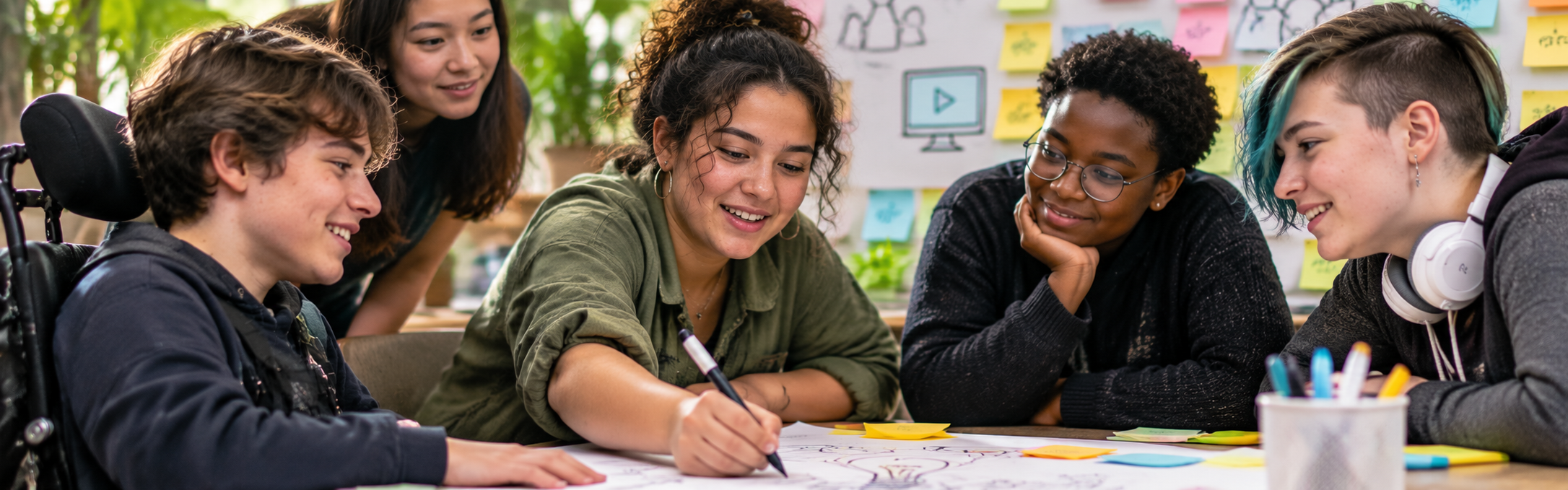
At its heart is the SEN Student Innovation Lab: an accessible, collaborative space where students work alongside educators, researchers, and EdTech developers to transform lived experience into meaningful participation and actionable innovation.
Students and educators will develop competencies in the Science of Learning, learner variability, AI literacy, and co-design, building the foundations for informed participation.
The Research Roadmap
Phase 1 — Identify the Gaps
Through a literature review and international surveys of SEN organizations and EdTech providers, researchers will identify where learner needs, scientific evidence, and technological innovation diverge, including barriers to accessibility, participation, affordability, and responsible AI.
Phase 2 — Co-Design
Working with an initial technology partner,
|