
Monthly Workshop Report of May 22, 2026 – Global Impact Projects: International Geneva, from framework to robustness
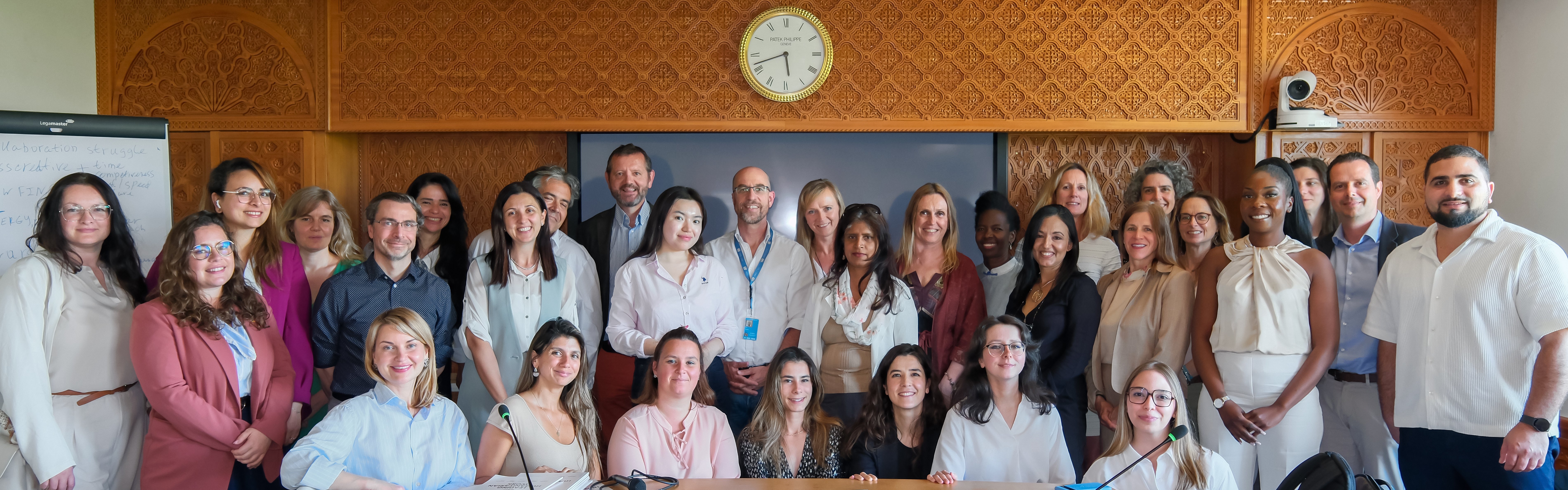
This Friday, May 22 at the UN, in the beautiful S4 room decorated by Morocco, a collective of 45 people and organizations gathered was beginning, very far upstream, the most demanding phase of the work underway.
Once the momentum of the initial idea has passed, beyond the simple desire to act, there comes a moment when an impact project must prove that it can stand on its own: stand the test of time, withstand complexity, withstand risks, and above all stand up to partners and funders who will not be content simply to believe — but who analyze.
Because this is indeed the heart of Global Impact Projects: moving from an International Geneva that talks about the world… to an International Geneva that produces architectures capable of acting on the world.
A look back at the methodological contributions provided by the Geneva Forum.
|
1. The reminder of the course: a Global Impact Project is not “one more project”
The morning began with a simple and structuring reminder: a Global Impact Project is not intended to create a new organization in addition to the others.
It is a federative architecture that aggregates what already exists, to enable the organizations involved in it to:
- secure and strengthen their capacity for action,
- obtain additional funding centered on their mission,
- and continue doing what they already know how to do… but with means and alliances proportionate to the challenges.
A Global Impact Project is not a list of activities either. It is not a catalogue. It is not a juxtaposition of intentions.
It is a single central project, designed to cross silos, in order to enable organizations with different cultures and mandates to work together without structural overload.
2. 2026 progress: from the architecture discussed to the written sketch
Another point was recalled regarding the stages already completed and those to come.
After the clarification and sizing phases, the projects are now beginning to enter the written sketch phase.
This is a major shift: when a project is written down, it becomes readable by a third party.
And from that moment on, it no longer exists only for those who already understand it. It must exist for:
- an organization considering joining,
- an institution seeking consistency between mandate and partnership,
- a funder who wants to understand what is financeable, why, and under what conditions.
This is why the sketch is not an atmospheric text.
It is a series of structuring documents, a stage resulting from an organized professional pathway.
3. Writing the sketch: a professional effort that must be remunerated
The Director of the Geneva Forum, Thomas EGLI, recalled that producing a high-quality sketch is advanced engineering work.
It is not simply a matter of “putting words down”.
It is about:
- transforming hypotheses into an architecture,
- making a value chain explicit,
- describing operable governance,
- setting out a credible economic model,
- and producing a set of documents capable of being challenged and e
|