
Report and Statement – Impact Finance: AGILE Tool Dry Run – Geneva Forum 2025
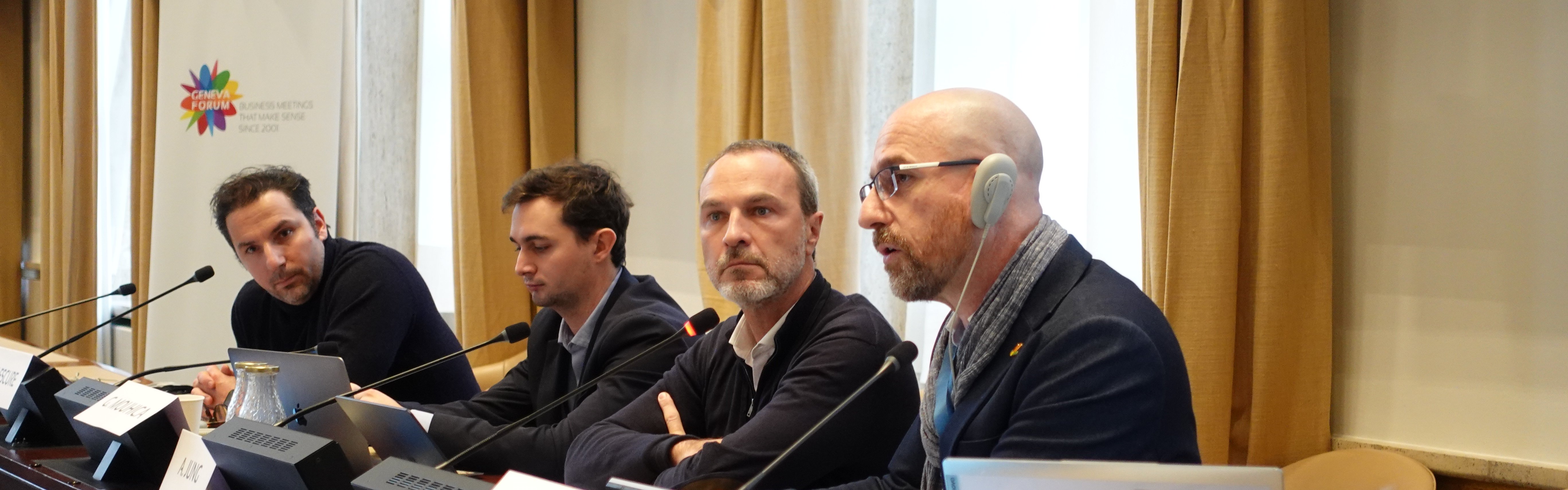
17th Geneva Forum – Palais des Nations (UN), Geneva – Monday, 8 December 2025

10th Annual International Conference on Philanthropy and Impact Investments for Peace and Development;
Impact finance and partnership opportunities: transdisciplinary projects, new sources of funding to support the goals of the United Nations and non-governmental organizations.

Afternoon Session: AGILE Tool Dry Run for Impact Finance.

The aim of the afternoon session was to examine, through several local and international projects, how the AGILE tool can assess the coherence, reliability, and maturity of impact projects, while testing its applicability in various operational contexts (urban, digital, educational, ecological, financial sovereignty).

  • The session was structured progressively, moving:
    • from an initial panel of concrete examples (impact projects),
    • to a methodological introduction of the AGILE tool,
    • then to usage examples in different sectors,
    • and finally to a full Dry Run in sub-groups, followed by feedback, critical debate, and an action-oriented closing.
  • Formats announced at the opening of the afternoon
    • formation of sub-groups of 5 to 6 people,
    • rapid selection of a real project (ongoing, known, in preparation, or used as a case study),
    • use of printed templates distributed in the room,
    • collective debrief towards the end of the afternoon, followed by a feedback exchange between the audience and the facilitation team.

The aim of a Dry Run is to check whether the tool allows fast progress without losing meaning, offering both training and a crash test.

The AGILE Tool Dry Run was facilitated by Thomas EGLI, Tristan LESCURE, Aymeric JUNG, and Grégoire MOUHICA.

Agenda Followed During the AGILE Sequence (Execution Timeline)

  • Introduction to the AGILE tool for impact finance
    • principles, structure, levels of use, evaluation philosophy
  • Examples of AGILE tool use across multiple sectors
    • digital projects, NGOs, agriculture/soil, culture, responsible extractives (case studies)
  • Hands-on workshop (Dry Run) in sub-groups
    • applying the grid, identifying strengths/weaknesses, internal discussion, and note consolidation
  • Group work debrief
    • presentation of results, consensus areas, areas of divergence, open questions
  • Discussion and methodological feedback
    • subjectivity, documentation, conditions for comparability, adoption by funders/governments, project protection
  • Q&A and closing
    • directions for the rest of Geneva Forum week and the coming months; invitation to networking

The AGILE Tool

Foundations

The Geneva for Future Foundation published a White Paper in which it proposes a simple and ambitious path: to realign finance with purpose, by building an AGILE, transparent, and regenerative model. The central idea is clear: finance can become a driver of systemic transformation if it finally connects philanthropy, investment, and field action.

The AGILE tool offers this common language, based on 5 families of criteria, each with 5 questions scored out of 6 points, for a total of 150 points.

A - Alignment
G - Governance
I - Intention
L - Leadership
E - Efficiency

A relevant, robust, and transversal tool, suitable for public, private, and hybrid projects—useful for filtering, analyzing, adjusting, prioritizing, and supporting projects—capable of creating a common language of impact, essential in multi-stakeholder contexts.

  • Three levels of use outlined during the session (maturity-building logic)
    • Level 1 – Sketch: rapid assessment, useful for first reading, filtering, or initial framing.
    • Level 2 – Assessment: documented assessment, where each score requires proof and a dossier.
    • Level 3 – Roadmap: transforming results into a roadmap (structuring priorities, evidence to produce, mechanisms to install, partnerships to secure).
  • Positioning: a deliberately simple and open reference framework, aimed at reducing fragmentation of proprietary grids
    • enabling cross-sector comparisons,
    • building a shared culture of impact,
    • and facilitating cooperation between project leaders, peers, experts, and funders.

The objective is not to replace all grids: the goal is to provide a shared backbone that anyone can use.

Experience Feedback: What the AGILE Test Demonstrated in Practice

Strategic Clarification and Revelation of Real Value

In the NRA case (companies supported in their carbon transition by a service provider), the tool significantly improved internal coherence within the beneficiary company, with an AGILE score rising from 74 to 130, demonstrating its ability to reveal previously diffuse value. AGILE functions like a focus tool: it identifies structuring elements, highlights undocumented areas, and strengthens project readability for funders. It offers a clear, fast, and global view of project quality.

  • Key takeaways from the audience
    • “Value” may exist without being visible; AGILE makes it explicit,
    • the score becomes useful when it triggers clarification, not when it passes judgment.

Precise Identification of Areas for Strengthening in Advanced Projects

In the case of the SSII Start-Up IT4Impact, the tool clearly distinguished robust dimensions (vision, transparency) from those requiring additional proof or mechanisms (diversity, partnerships, governance). The tool acts as an evaluation switchboard, pointing to where documentary, strategic, or organizational effort should focus.

  • Key takeaways from the audience
    • a “good” project is not necessarily a “complete” project,
    • completeness (proof + governance + partnerships) is a condition for fundability.

Constructive Contribution for Projects in Transition or Emerging

In the Swiss Soil and Khettan cases, AGILE highlighted: the strength of societal ambition (food sovereignty, living soils), the real constraints of a young organization, and the temporal tensions between ecosystem pace and funder expectations. The score of 92/150 was used not as a verdict but as a progression map.

  • Key takeaways from the audience
    • the tool protects emerging projects when it helps build a trajectory, not to exclude them,
    • the gap between ecological long timeframes and financial short timeframes must be made visible and managed.

Additional Examples Used to Test Transversality

Several case studies were used to illustrate the flexibility of the framework:

  • an IT start-up serving NGOs,
  • an agricultural/technological project related to soils,
  • a cultural project (festival) as a vehicle for territorial development,
  • a responsible extractive/industry case (label or practice standard).
    These examples demonstrated that the grid is usable beyond the “classic” climate sectors, provided that the key principle is accepted: a score only has value if it is backed by observable and documentable elements.

AGILE does not replace reality: it forces a comparable description, in a fluid and simple way, for daily and practical use.

Dry Run: Execution, Outputs, and Learnings

The hands-on workshop was the core of the operational test.

  • Working method in sub-groups
    • groups of 5–6 people,
    • selection of a concrete project,
    • filling out the grid, discussing scores, identifying challenges,
    • writing observations: strengths, weaknesses, risks, priority areas for improvement.
  • Projects actually evaluated by the groups (examples from debriefs)
    • an application connecting investors / project leaders,
    • a trade and partnership platform Europe / Latin America,
    • a Congolese cultural project (festival) with economic, social, and territorial dimensions.
  • Key learning from debriefs
    • the tool structures thinking and makes trade-offs visible,
    • the main role of evaluators is scoring qualitative criteria (“soft factors”) by providing shared references, examples,
    • collective discussion around the AGILE grid quickly improves score quality by revealing missing evidence.

The Dry Run revealed a decisive point: collective intelligence transforms an individual subjective score into a shareable diagnosis.

Convergence of Observations: Overall Relevance of the AGILE Tool

A Confirmed Strategic Usefulness

AGILE:

  • makes projects comparable despite their diversity
  • clarifies impact trajectories
  • supports decision-making
  • facilitates dialogue between project leaders and funders
  • strengthens the credibility of impact projects
  • Usefulness observed during the session
    • for project leaders: turning an “interesting” project into a “fundable” one,
    • for funders: compare, question, prioritize without getting lost in narratives,
    • for partners: identifying what is missing to cooperate (governance, roles, evidence, model).

Identified Success Conditions

  • Fast use (under one hour)
  • Minimal required training to ensure consistent interpretation
  • Systematic dual evaluation that enhances rigor and reduces individual bias (PEER)
  • Clarification discussed regarding scoring scale (notably 5/6 vs 6/6)
    • level 6 is reserved for projects whose positive impact increases structurally with growth (not just those that reduce a negative impact).
    • this point will be better illustrated in the AGILE user guide, as it determines comparability.

A 6 is not just a better 5: it’s a model where growth mechanically increases positive impact, because it is embedded in the project’s business model.

Questions and Suggestions

The audience emphasized that without clear benchmarks, scores can vary based on evaluator sensitivity; it is recommended to use the AGILE tool with multiple people to generate a calibration that reduces subjectivity in scoring, and to cite concrete examples for each level (1–6).

A question was raised about protecting project leaders and their ideas; confidentiality / intellectual property protection support may be needed in some cases (Non-Disclosure Agreement, etc.).

Several potential development pathways:

> Enable citizen voting (weighted, distinct from expert score) to integrate a global perception of the project’s presentation

> Structure expert committees for score calibration and validation, ensuring more stable and rigorous readings

> Weight evaluators based on their role

  • self-evaluation by the project leader
  • peer evaluation
  • evaluation by local actors
  • expert evaluation
  • financial evaluation

> Create an AGILE app to generate visual summaries (radar charts), compare, compile, aggregate, or link projects

> Create a community of AGILE win-win projects that perpetuate the AGILE framework. These projects in turn benefit from AGILE ecosystems for long-term collaboration, merger, scaling...

> Map the global AGILE project community: projects connected by SDGs, AGILE scorecard, real or potential partnerships

> Turn this map into a deep impact visualization tool assessed by AGILE, and a completeness analysis instrument for transversal / scalable projects, while showcasing the international success of this Geneva-based framework

  • Critical questions addressed in open debate
    • potential adoption by international funders and foundations: need for a simple standard + crash-test proof of robustness,
    • applicability to governments: relevant if the tool remains readable and shareable,
    • open source vs protection: while the tool is open-source, confidentiality options are necessary depending on context,
    • mission fidelity: importance of Alignment / Intention / Governance dimensions to ensure money remains in service of the project.

What we are seeking is not a “perfect score.” It’s a tool that allows money to serve the mission and increase both its impact and returns.

Decisions, Actions, and Next Steps

  • Announced and initiated actions
    • invitation to continue workshops during Geneva Forum week,
    • networking proposal (dinner) and continuation of informal exchanges,
    • transformation of recordings into statements and roadmaps,
    • announcement of openings on the Scientific and Operational Councils of the Foundation,
    • organization of additional dry runs (Geneva, Zurich, Paris, Luxembourg, London) during December–January,
    • launch of the AGILE platform pilot in the first quarter of 2026.

The Dry Run is a starting point for building a common practice and a community of evaluators using the AGILE tool, and ensuring it is maintained by the community.

Conclusion

The day clearly demonstrated that Geneva remains one of the few places capable of articulating diplomacy, finance, innovation, and field action to meet the systemic transformations underway.

The urgency of a common language of impact, the need for controlled financial hybridization, and the strategic value of the Geneva cluster as a global governance platform confirm the potentially central role of AGILE: a reliable methodological tool, capable of clarifying trajectories, making heterogeneous projects comparable, and strengthening the credibility of impact initiatives.

Its value lies as much in its capacity to offer a development tool for project leaders, to reveal project completeness, as in its potential to invite shared and structured governance of impact.

Through case studies and the Dry Run, the AGILE tool demonstrated its ability to reveal internal project coherence, identify progress areas, and facilitate rigorous dialogue between project leaders, peers, and funders.

To succeed, transitions require simple tools, strong coalitions, clear governance, and a shared culture of impact. Geneva has these assets. AGILE offers the language. The collective dynamic initiated during this session thus paves the way toward more transparency and efficiency in service of expected economic, societal, and ecological goals.

AGILE is not just an evaluation tool, it is also a method for alignment. And an invitation to produce, together, fundable projects without losing their purpose.

Report and statement adopted in Geneva as a summary of the afternoon session of 8 December 2025, dedicated to the AGILE tool Dry Run.

Final report prepared and released by Mr. Thomas EGLI, Director of the Geneva Forum, and Ms. Chloé LAROSE, Deputy Director of the Geneva Forum, based on detailed note-taking by Ms. Cécile CAMPAGNE, member of the organizing team. Review and contribution: Mr. Tristan LESCURE, Mr. Aymeric JUNG, and Mr. Grégoire MOUHICA