
Management workshop: Strategic Foresight applied to Global Impact Projects
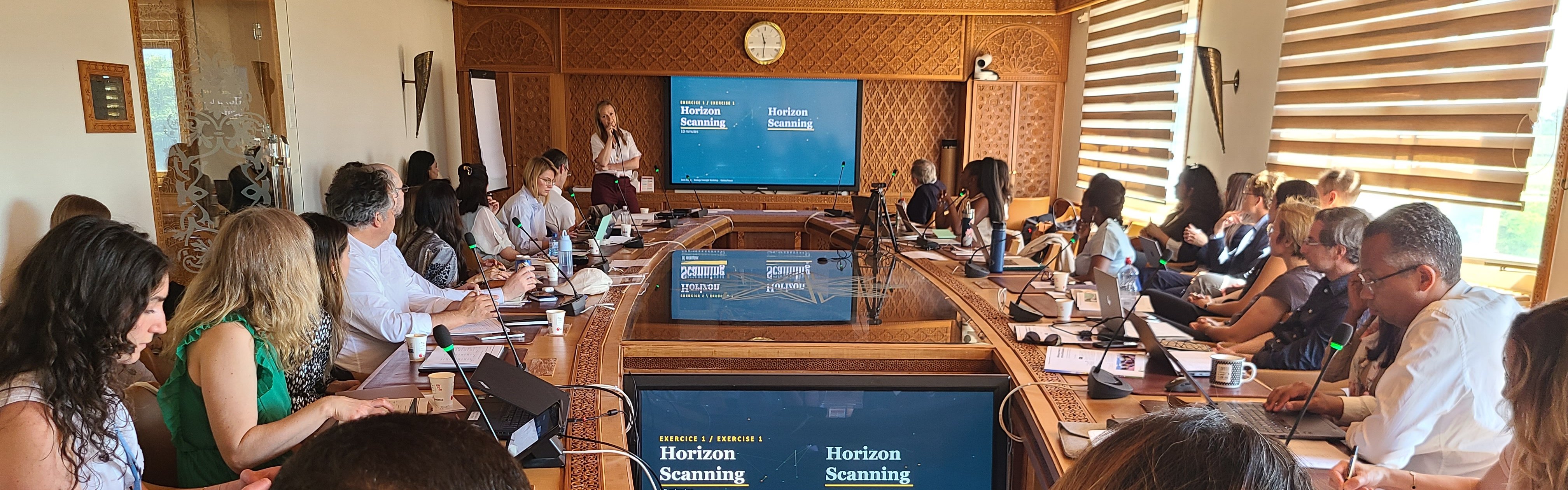
Facilitated by Daria Busset as part of the Sustainable Management Workshop of May 22, 2026 at the UN.
There comes a moment in the life of an impact project when one understands that the question is not only: “Is the idea good?”
The real question becomes: Will this project still stand when the world changes around it?
This is exactly why, in the progress pathway of the Global Impact Projects, one management focus is regularly devoted to something it is very important not to underestimate: robustness.
Indeed, a project can be brilliant and yet fail, not for lack of will, but because of:
- technological obsolescence,
- regulatory reversal,
- reputational shock,
- economic fragility,
- poorly framed governance,
- or a simple inability to absorb scale.
|
Why Strategic Foresight has become a key competency
Strategic Foresight is not an “inspirational” discipline. It is not “imagining futures” in the abstract sense.
It is an operational method for identifying, before it is too late:
- the risks that can break a project,
- the opportunities that can propel it,
- the blind spots that destroy credibility,
- and the structural vulnerabilities that make a model non-financeable.
In practice, two methods are particularly useful, because they can be applied directly to a sketch:
Horizon Scanning
Looking beyond the project itself.
Scanning the environment to identify weak signals that point to:
- a technological disruption,
- a change in standards,
- a geopolitical shift,
- a cultural mutation,
- a market transformation,
- or a new requirement from funders.
Scenario Building
Building several coherent scenarios, then asking the simplest question:
In each of these possible worlds, does our project hold up?
And if not:
What needs to be adjusted now so that it holds up tomorrow?
What changes everything is that these methods are not an academic exercise.
They become a decision-making tool.
What this immediately produces in a project
When these methods are applied seriously, very concrete improvements begin to appear:
1) A prioritization of risks that prevents dispersion
We stop piling up lists.
We choose a few critical risks, those that can kill the project.
2) Real mitigation levers
Not promises.
Mechanisms:
- safeguards,
- clauses,
- proof mechanisms,
- pilot stages,
- redundancies,
- independent governance,
- cooperation rules,
- relevant indicators.
3) A clarification of public–private cooperation rules
Because one of the most dangerous areas for the credibility of an impact project is often there: ambiguity.
- Ambiguity around roles.
- Ambiguity around interests.
- Ambiguity around data.
- Ambiguity around responsibilities.
4) A strengthening of transparency and accountability mechanisms
A solid project is not one that promises.
It is one that can demonstrate, correct, and improve.
5) More credible writing
Strategic Foresight even improves the narrative, because it drives out fragile formulations:
- announcement effects,
- overly quick promises,
- “everyone will get on board”,
- “it will finance everyone”,
- unrealistic trajectories.
We move from a convincing t
|