Proceedings Citizen and Participatory Science Geneva Forum 2025
Citizen and Participatory Science – Participatory Research – Crowd-Innovation – Fab Labs for Peace and Development

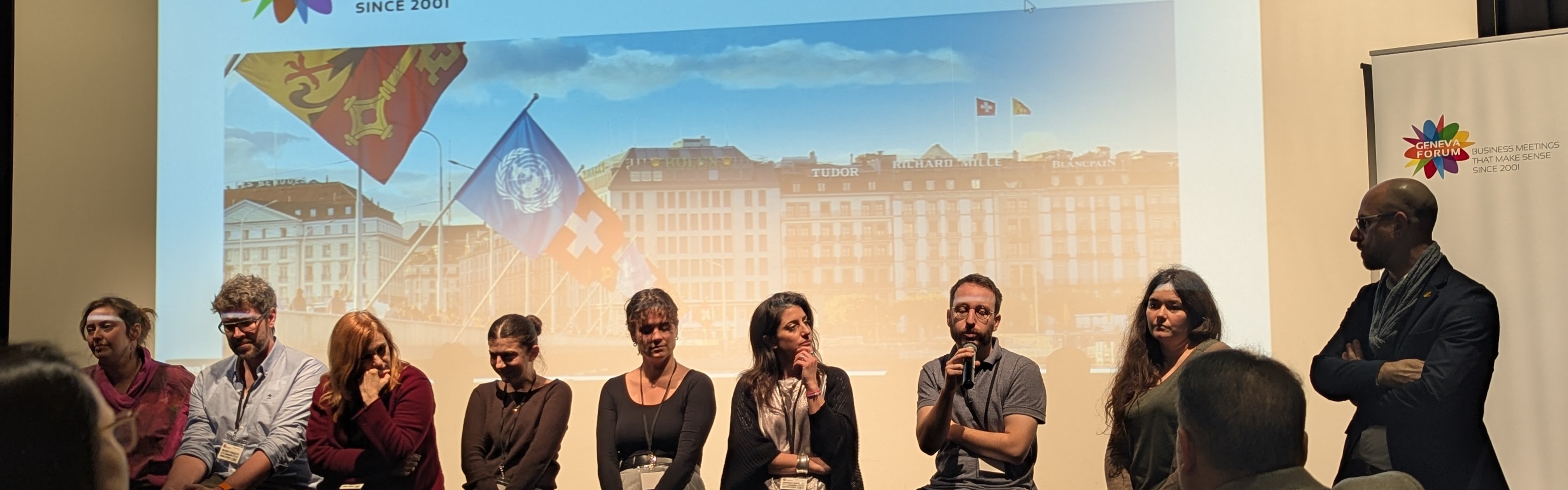
On Wednesday afternoon, 10 December 2025, the Geneva Forum was held at the Théâtre du Centre l’Espérance for its 6th Annual International Conference on citizen science, participatory research, crowd-innovation, and Fab Labs for peace and development. This edition, entitled “Large-Scale Alliances of Citizen Science to Overcome the Silos of International Geneva and the UN System in a Lasting Way, and Open New Sources of Impact Finance”, combined pitches and an interactive round table to explore the power of citizen alliances in building sustainable bridges and catalyzing cross-sector cooperation.

This session also had an operational logic: to begin refining impact projects currently being structured, by integrating what citizen science and Fab Labs bring in terms of methods, mobilizable audiences, and achievable results, in preparation for presentations scheduled at the UN on Friday.

The afternoon was chaired by Thomas EGLI, CEO of the Geneva Forum, and co-hosted on the citizen science side by Chloé LAROSE (Geneva Forum team), and on the Fab Labs side by Olivia KOTSIFA (co-chair of the Fab Lab session), with simultaneous French/English translation provided by the interpreting team mobilized for the entire week.

Transformative Power of Participatory Research and Citizen Alliances

The first part of the afternoon highlighted how locally grounded, globally connected alliances enable the generation of robust data, the building of trust, and the linking of biodiversity, governance, education, and inclusive partnerships.

Citizen Science – K2W Glideways Program (Australia): Restoring Habitat Connectivity

Mary Bell introduced, with Gigi Bonnet (student in Geneva, originally from Australia), the K2W Glideways program, a citizen alliance aiming to restore habitat connectivity along a reference corridor (Kanangra-Boyd to Wyangala) in southeastern Australia, with the Greater Glider (a large gliding marsupial) as the umbrella species.

  • The species is highly dependent on old-growth forests (tree hollows, food resources), and its future has severely declined after the 2019 fires, with population drops of up to 80% in some areas.
  • Identified threats include: ongoing habitat loss, exploitation/pressure on native forests, and intensification of climate extremes.
  • The program illustrates a highly operational approach to citizen science, mobilizing a wide range of actors: landowners, schools, volunteers, community groups, scientists, and protected area managers.

Tools and protocols used:

  • workshops to train volunteers and set up equipment (including camera traps),
  • BioBlitz (intensive biodiversity inventories),
  • collection of environmental DNA (eDNA) and samples (e.g., swabs, water) to detect species presence,
  • exploration of potential acoustic signatures,
  • thermal drones to estimate populations, even detecting juveniles in priority zones.

The project also highlighted a structural issue for scaling: data fragmentation across platforms (e.g., iNaturalist, NatureMapper), which complicates integration, even as platform maintenance funding remains limited despite increasing participation. Particular attention was given to the privacy of landowners and data quality/validation (NatureMapper feeds into the Atlas of Living Australia, with expert moderation).

Key conclusion: a citizen alliance is not just a data collection mechanism; it is a local cooperation infrastructure, stabilizing monitoring practices over time and turning citizen engagement into conservation outcomes.

European Citizens’ Initiative: Toward Participatory Democracy Enhanced by Participatory Research

A second pitch focused on the European Citizens’ Initiative, a participatory democracy tool of the European Union enabling citizens to petition the European Commission via an initiative requiring a high support threshold (around one million), based on a transnational committee. The speaker highlighted a paradox: a powerful but underused tool, whose inclusiveness and impact are hampered by low participation and institutional rigidities.

The proposed idea: to integrate the tool into a decentralized participatory research approach, where action, community, collaboration, and evaluation take precedence.

Four methodological principles were emphasized:

  • full participation,
  • community,
  • multi-stakeholder collaboration (“team science”),
  • participatory evaluation (often missing).

Five key challenges were identified to make this approach credible and governable:

  • leadership (who leads and controls, and how to ensure transparency),
  • data collection and governance,
  • selection criteria for civil society partners,
  • managing political dynamics,
  • institutional accountability.

The intervention concluded with the idea of horizontal leadership (“zero leadership”) and rebalancing: placing academic and citizen communities on equal footing to reduce power asymmetries and enable truly participatory agenda-setting.

Citizen Science – OSI-PANTHERA: Snow Leopard and Myricaria (Kyrgyzstan)

Guillaume Ledoux then presented a conservation biology research project based on a field observation reported by OSI-PANTHERA: the repeated presence of plant fragments (Myricaria) in snow leopard feces. The scientific issue: understanding this behavior, well-known locally (guides, reserves), but still poorly described in the literature.

The presentation showed how participatory science “unlocks” research otherwise limited by field access and administrative complexity:

  • rare and elusive species, remote mountain areas, need to reach the “heart” of reserves,
  • heavy logistics (camping, travel, horses, resupply),
  • language barriers,
  • regulatory constraints (protected species, CITES) making sampling, export, and certain analyses costly and complex.

The role of OSI-PANTHERA:

  • local presence, guides fluent in local languages (Kyrgyz, Russian) and able to obtain permits,
  • handling logistics and administration,
  • delegating sample collection to trained participants, who collect and transmit to scientists.

Results and lessons:

  • in four months, 70 samples collected across four reserves (compared to academic approaches often covering only one reserve over several years for similar volumes),
  • increased robustness through multiple expeditions and collectors (reducing the risk of “counter-results” from rare samples),
  • self-funded model: once set up, collection can continue via expeditions and participants, which is key for underfunded topics.

Underlying objectives:

  • confirm and describe the observed behavior,
  • integrate Myricaria into conservation and, if applicable, breeding programs to preserve little-known natural behaviors,
  • share knowledge with local actors (rangers, guides) and strengthen public education.

Beyond biology, the initiative highlighted that such cross-border projects are also vehicles for cultural exchange and cooperation, despite major administrative challenges.

How Fab Labs Contribute to Citizen Science and the SDGs at a Global Scale

The second part of the afternoon explored Fab Labs as citizen infrastructures for fabrication, learning, prototyping, and problem-solving, capable of accelerating solution production in support of the SDGs.

Introduction to Fab Labs: Democratizing Access to Technology

Olivia Kotsifa, founder of the first mobile Fab Lab in Greece, reminded us of the nature of Fab Labs: equipped spaces (3D printers, laser cutters, CNC machines, etc.) where people learn by making, individually and collectively. The network has grown significantly since the first Fab Labs, now numbering around 3000 worldwide.

Central philosophy:

“We can make what we need.”

By design, Fab Labs significantly contribute:

  • to SDG 12 (responsible consumption and production) via repair, reuse, short supply chains, low-impact prototyping,
  • to SDG 4 (quality education) via hands-on learning, creativity, and empowerment.

The mobile approach was presented as a major lever to reach rural or remote communities, underserved by traditional infrastructure.

Measuring Fab Lab Impact: “Impact Pathways” and Mindset Change (Belgium)

Stijn de Mil, founder of FabLabFactory (near Brussels), emphasized a structural challenge: Fab Lab impact is often diffuse, multi-stakeholder, and long-term, making it hard to capture with traditional metrics. He proposed focusing on “impact pathways” rather than immediate results alone.

Four levels of impact were discussed:

  • individual (skills, confidence, autonomy),
  • project (prototypes, tested solutions),
  • community (participation, collaborations),
  • system (influence on public policies, institutions, norms).

Concrete examples:

  • “Makers against Corona”: massive production of equipment (e.g., face shields) for healthcare workers,
  • mobile setups and local coalitions,
  • “Learn Make Share”: explicit integration of SDGs into activities.

The most structural point, according to him, is not the number of items produced, but the mindset shift:

From spectator to actor: seeing the world as “makeable.”

Fab Labs and Social Transformation: When Evaluation Must Capture the Invisible (Amsterdam / Rotterdam)

Anne Vlaanderen, educator and creator, shared insights from programs reaching several thousand children, emphasizing a key issue: current evaluation frameworks excel at counting what is quantifiable, but fail to capture slow, relational, and cultural transformation.

She advocated for evaluation approaches that value:

  • curiosity,
  • cross-disciplinary fertilization,
  • feelings of belonging and empowerment,
  • transformation trajectories rather than one-off transactions.

Examples of “cross-fertilization”:

  • a BioHack Academy participant demonstrated how oyster shells (restaurant waste) can become biocomposites,
  • artists working on fungal expressions (lichens) introduced practical methods to researchers for cultivating difficult fungi in vitro.

Key conclusion: the Fab Lab is not just a workshop; it is an ecosystem of unexpected innovations born from the meeting of publics, professions, and disciplines.

Equity and Impact: “Who Is the Impact For?” (Switzerland, La Chaux-de-Fonds)

Mélanie Thomas, president of a Swiss Fab Lab (La Chaux-de-Fonds), raised a central question: “Who is the impact for?” She stressed the need to go beyond simple metrics (number of workshops, number of participants), and to also measure:

  • who actually benefits,
  • who gains skills and confidence,
  • which barriers have been removed.

She presented a 3-step approach (UCL):

  • Prepare: identify barriers (social, economic, cultural, psychological, logistical),
  • Do: co-production, inclusive governance, removal of obstacles, transformative pedagogy,
  • Evaluate: measure with members, not just for them.

“Equity is not a luxury; it’s a measure of impact.”

She also discussed the evolution of Fab Lab governance toward more distributed forms (notably holacracy) to align method, values, and outcomes.

Interactive Round Table: Points of Convergence, Tensions, and Learnings

Discussions revealed several cross-cutting themes.

  • Diversity and Complementarity of Fab Labs: possible coexistence between university Fab Labs (often focused on engineering/safety) and associative/community Fab Labs (focused on social projects, inclusion, empowerment).
  • Mobile Fab Labs: unique ability to reach rural or remote areas.
  • Learning Through Failure: consensus on the value of “learning through failure”; allowing mistakes makes hands-on learning truly possible and emancipatory.
  • Volunteering vs. Compensation: discussion on the limits of purely volunteer-based models (risk of burnout), and the need for sustainable models.
  • Impact Measurement and Evaluation: criticism of indicators designed for predetermined outcomes, inadequate for capturing subtle long-term transformation.
  • Skills Recognition: discussions on micro-credentials, OpenBadges, and Fab Lab “passports,” with the idea of a (notably European) open badge infrastructure connectable to learning paths and professional networks.

Q&A sessions also addressed:

  • the impact of Australian fires (scale of losses, urgency of monitoring),
  • administrative barriers in international research,
  • levers to engage youth and local communities.

Complementary Pitch – Humanitarian Project: “Un Geste Divin”

After the Q&A session, an additional presentation introduced the association “Un Geste Divin,” based in Belgium and active through networks in many African countries. The initiative aims to build essential infrastructure for children displaced by war and vulnerable populations, notably:

  • schools,
  • hospitals,
  • boreholes,
  • orphanages.

Achievements were mentioned (examples in Rwanda, Ghana, Cameroon, including an orphanage for around 300 children). A 2026 ambition was shared: to launch a program to build several schools in various African countries, with possible extensions to Cambodia.

This pitch was discussed as a case illustrating the value of multi-stakeholder alliances (on-the-ground + diaspora + technical partners) and of fabrication/learning mechanisms (Fab Labs) to accelerate the local production of suitable and sustainable solutions.

Summary and Next Steps

The afternoon clearly demonstrated, through very concrete examples, how everyone can become an agent of positive change by meaningfully participating in structured citizen initiatives.

Citizen contributions:

  • increase project feasibility (human capital, field presence, continuity),
  • enrich projects (diversity of viewpoints, collective intelligence),
  • strengthen understanding and ownership of issues (biodiversity, climate, education, governance),
  • accelerate scaling when concepts are replicable (e.g., Fab Lab network).

The next day would shift the focus from citizen science to the role of citizens in preserving peace and global security, through “citizen diplomacy.”

Operational Follow-Up Discussed

  • Update of project sheets (website) by participants involved in the projects, ahead of the UN presentation sessions.
  • Sending by the Geneva Forum team of reflection questions on citizen science, and the expected parameters/methodology for refining impact projects.
  • Preparation of project presentations for Friday afternoon (UN), integrating methodological inputs from participatory science and Fab Labs.

Final report completed and released by Mr. Thomas EGLI, CEO of the Geneva Forum, and Ms. Chloé LAROSE, Deputy Director of the Geneva Forum, based on the careful note-taking work of Ms. Romy NIJHOF, member of the organizing team.